Transnational meeting and dialogue seminar advance Pillot Project in Prague
Consortium meeting and transnational seminar mark new milestones for our language and culture learning and social inclusion initiative. This summer, the Pillot Project team gathered in Prague for a transnational project meeting, hosted by Centrum demokratického vzdělávání.
The event brought together educators from across Europe to refine and advance the project’s key outputs, focusing on the preservation and sharing of integrated learning experiences, and practical resources. The meeting centred on advancing the project’s core mission: promoting inclusive language learning opportunities through local culture and cultural heritage for learners with refugee and migrant backgrounds.
During the event, the team concentrated on finalizing deliverables, which aim to preserve and share the purpose and experiences of integrated learning activities developed and tested in 2024 and 2025. Discussions included development of additional learning materials. These resources cover a diverse range of languages - Polish, Romanian, Italian, Czech, French, Luxembourgish, and English. The materials are being designed to facilitate European integration and language-heritage learning in an innovative format - a shared universal textbook.
By integrating language acquisition with cultural exploration - such as museum visits, storytelling, and hands-on activities - learners engage in meaningful, context-rich experiences.
In addition, the consortium worked on the draft of Good Practices Guide, a comprehensive material offering insights into the integrated education approach, highlighting experiences from specific cultural heritage areas, and a curated collection of practical activities tested and adapted for the project intent.
The Pillot approach is grounded in Content and Language Integrated Learning (CLIL), experiential learning, and participatory practices. By integrating language acquisition with cultural exploration - such as museum visits, storytelling, and hands-on activities - learners engage in meaningful, context-rich experiences. This approach supports accessibility for diverse learners, including those with limited literacy or interrupted education.
The key methodological foundations of the project include:
- CLIL and cultural immersion: Activities like role-plays, art workshops, and identity collages promote experiential learning and intercultural dialogue.
- Gamification and mobile learning: Outdoor exploration and digital tools enhance motivation and real-world language use.
- Visual and reflective approaches: Visual thinking strategies and dream maps foster creativity and emotional engagement.
- Storytelling and object-based learning: Personal narratives and cultural mediation empower learners to connect language with identity and memory.
- Hands-on and creative learning: Practical, collaborative tasks build confidence and social integration for beginners.
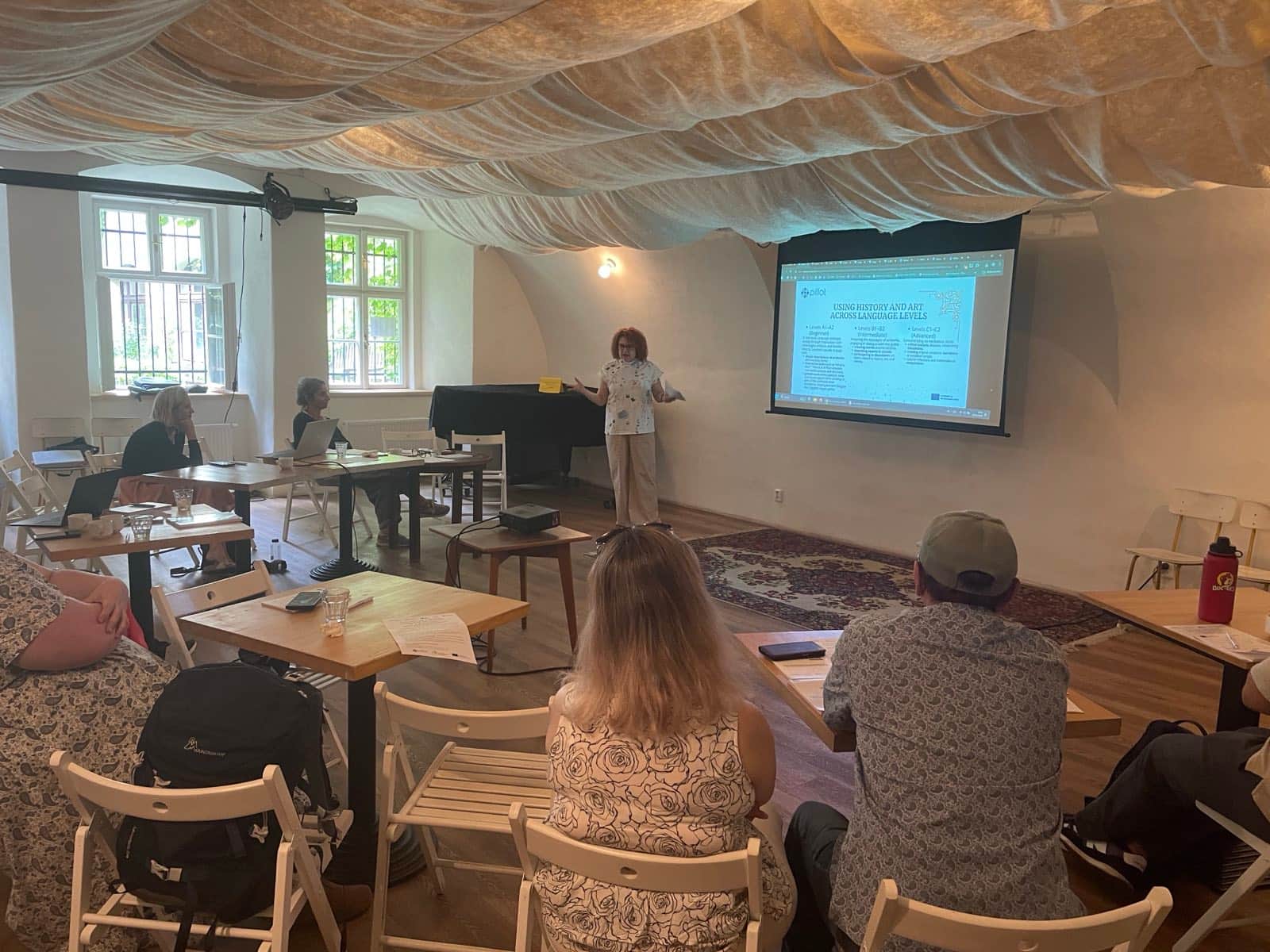
In addition to the internal working meeting, the consortium organized its first joint transnational seminar for local educators and professionals working with refugees and migrants in Prague. The seminar provided a platform for reflection, dialogue, learning, and networking, fostering new ideas and potential for future collaborations.
The seminar, titled “Culture as a Bridge: Language Education from the Perspective of Cultural Heritage“ was open to educators, activity facilitators, cultural and non-profit organization workers, learners and anyone engaged in educating foreigners or integrating migrants and refugees into their activities. It featured these themes:
- Introduction to the Pillot's interdisciplinary approach: An overview of the experimental collaboration in adult education, connecting language and culture educators.
- Integrated learning concept: Insights into the CLIL methodological approach of combining language learning with cultural heritage education.
- Practical field testing experiences: Concrete examples and reflections of how to engage migrant learners in activities related to culture and cultural heritage from all partner countries perspectives.
- Networking opportunities: Opportunity to discuss the potential of language and culture education in international settings.
Members of the project from all countries participated in the event and shared conclusions on the implementation phase: Šárka Paličková and Gabriela Boháčová (Centrum demokratického vzdělávání, Czech Republic); Katarzyna Žák-Caplot (Museum of Warsaw, Poland); Chiara Damiani (Stazione Utopia, Italy); Andreea Iasko (Transylvanian Museum of Ethnography, Romania) and Patricia Awe (inlingua® Luxembourg).
The Pillot Project is now looking forward to a series of upcoming events across all partner countries, including a joint international conference at the Museum of Warsaw later this year. This event will bring together not only the Pillot consortium but also scholars and experts to discuss the integration of language learning with cultural heritage all across Europe.
About the PILLOT Project
The PILLOT Project focuses on inclusive education, cultural heritage, and language learning for migrant inclusion. Through cooperative partnership, the European consortium develops innovative approaches and shares best practices in adult education, making language learning more human, creative, and connected to the contemporary and diverse world we live in.